

Buying an auto shop franchise can give you a recognized brand, operating systems, training, and supplier relationships. However, startup costs vary widely by brand and service model. The right choice depends on your capital, market, management skills, and preferred repair services.
Direct answer: Many established U.S. automotive repair franchises require roughly $200,000 to more than $700,000. Costs can rise with real estate, equipment, construction, inventory, and working capital. Compare the current FDD, territory, fees, staffing needs, and unit economics before investing.
| Key factor | What prospective owners should know |
|---|---|
| Typical business models | Full-service repair, transmission repair, quick maintenance, tires, and specialty services |
| Major startup expenses | Franchise fee, equipment, property, construction, inventory, technology, and working capital |
| Important FDD sections | Items 5, 6, 7, 11, 19, and 20 |
| Main operating challenge | Recruiting technicians while maintaining productive bay utilization |
| Financing | Cash, conventional lending, SBA-backed financing, or approved combinations |
| Best comparison metric | Sustainable cash flow after royalties, payroll, debt service, and other expenses |
Auto Shop Franchise Options to Compare in 2026
No single brand is automatically the right choice for every investor. Service mix, territory economics, capital requirements, and owner expectations differ substantially. These five concepts provide useful examples of the choices available to U.S. buyers.
| Franchise | Reported initial investment | Model | Potential fit |
|---|---|---|---|
| Midas | About $199,000–$739,000 for a new site | Full-service automotive care | Buyers seeking a broad service menu |
| AAMCO | About $276,600–$407,200 | Transmission and total car care | Operators interested in repair specialization |
| Christian Brothers Automotive | About $454,250–$582,400 | Full-service repair | Business-focused operators comfortable with its model |
| Jiffy Lube | About $236,000–$452,650 | Quick maintenance | Operators focused on throughput and repeat maintenance |
| All Tune Total Car Care | About $245,000–$470,000 | Full-service repair | Buyers seeking a traditional repair-center format |
Investment figures are starting points, not final budgets. Midas, AAMCO, and Christian Brothers publish current investment information through their franchise sites. The Jiffy Lube and All Tune figures come from a 2026 FDD-based comparison.
Midas
Midas combines maintenance work with brakes, tires, exhaust, suspension, steering, and other services. Its current franchise site lists new-site investment around $199,000 to $739,000. Conversion opportunities may also suit owners who already operate an independent facility.
Pros
- Broad range of repair and maintenance services
- Established consumer brand
- New-site and conversion formats
- Training and operational support
Cons
- Significant equipment and facility costs
- Local competition can be intense
- Revenue still depends heavily on execution and staffing
AAMCO
AAMCO is known for transmission work but now offers broader vehicle-care services. Its franchise site lists total investment around $276,600 to $407,200, including a $45,000 franchise fee. The company also reports a 7.5% royalty on gross annual sales.
Pros
- Strong position in transmission repair
- Broader total-care services
- Established training and marketing systems
- Lower published investment ceiling than several full-service alternatives
Cons
- Royalty expenses reduce store-level cash flow
- Specialized repair work requires capable technicians
- Owners still need strong local marketing and customer service
Christian Brothers Automotive
Christian Brothers Automotive takes a distinctive approach to full-service vehicle repair. Its franchise FAQ estimates startup costs between $454,250 and $582,400. The company also says most new owners don’t need automotive experience.
Pros
- Detailed site-selection support
- Full-service repair model
- Business-focused franchisee selection
- Training for owners without automotive backgrounds
Cons
- Higher capital requirement than some alternatives
- Site development can take considerable time
- The company’s culture and operating model will not suit every investor
Jiffy Lube
Jiffy Lube centers its model on frequent maintenance and high customer throughput. A 2026 franchise comparison estimated startup costs between $236,000 and $452,650. Its service pattern can generate recurring visits when stores build strong local customer retention.
Pros
- Recognized maintenance brand
- Repeat-service potential
- Process-oriented operating model
- Less dependence on complex repair work than full-service centers
Cons
- Throughput matters greatly
- Staffing consistency affects customer experience
- Local quick-service competition may pressure pricing
All Tune Total Car Care
All Tune represents a more traditional full-service repair-center model. A recent franchise comparison estimates the investment at $245,000 to $470,000. Its broader service offering creates opportunities beyond routine oil-change traffic.
Pros
- Full-service repair capabilities
- Maintenance and higher-ticket work
- Training for store operations
- Moderate investment compared with some larger concepts
Cons
- Technician recruiting remains important
- Higher-ticket repairs require customer trust
- Local reputation can matter as much as brand recognition
Why Automotive Repair Demand Remains Attractive
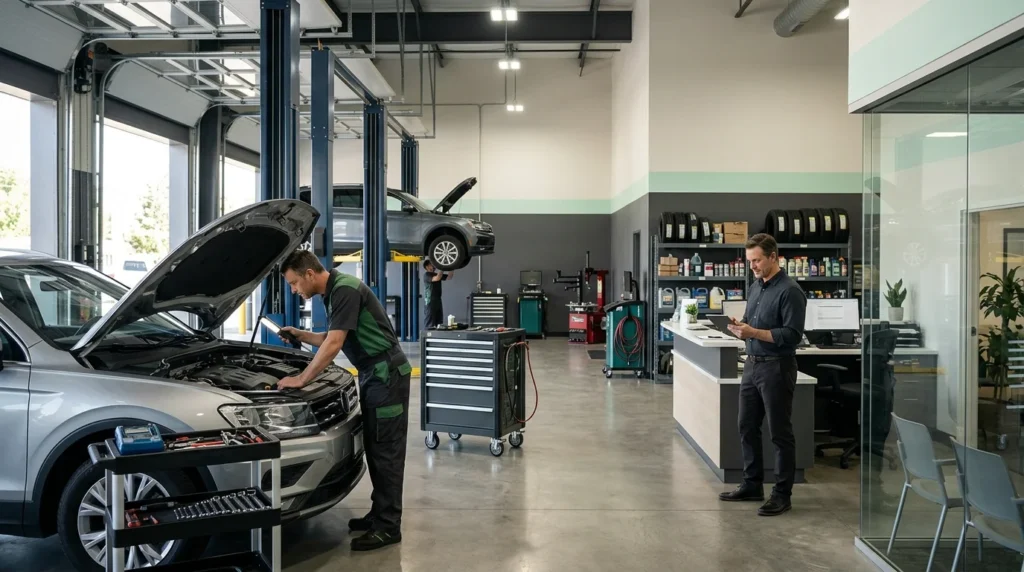
Americans are keeping vehicles longer, which supports aftermarket repair demand. S&P Global Mobility reported an average U.S. light-vehicle age of 12.8 years in 2025. It also counted about 289 million light vehicles operating nationwide.
Older vehicles generally require more maintenance, replacement parts, and repair work. Yet strong demand does not guarantee a profitable individual location. Rent, payroll, competition, pricing, and productivity still determine store-level economics.
Labor deserves special attention before you select a territory. The Bureau of Labor Statistics projects 5% technician employment growth from 2025 through 2035. It also projects about 66,200 automotive technician openings annually during that period.
How Much Capital Should You Plan For?
The franchise fee represents only one part of the required investment. Your budget may include construction, lifts, diagnostic equipment, signage, software, inventory, insurance, permits, and opening marketing. You also need enough working capital to cover the ramp-up period.
Create several cash-flow scenarios before signing a franchise agreement. Model lower sales, slower hiring, higher payroll, and delayed break-even assumptions. Businessstry’s cash flow statement guide can help you separate operating cash from financing activity.
Financing doesn’t eliminate the need for adequate reserves. Loan payments can increase pressure during a slow opening period. Compare financing structures with your projected monthly cash needs before committing capital.
Read the Franchise Disclosure Document Before Investing
The Franchise Disclosure Document should be central to your due diligence. Federal rules require franchisors to provide it at least 14 days before certain payments or binding agreements. The FTC recommends reviewing all 23 numbered FDD items before investing.
Start with Items 5 through 7 for initial and ongoing fees. Review Item 11 for assistance, advertising, systems, and training obligations. Examine Item 20 for openings, closures, transfers, and changes across the franchise network.
Item 19 deserves careful interpretation when a franchisor provides financial performance information. Check which units were included and how long those locations operated. A large average means little without knowing the sample behind it.
Franchise Shop vs. Independent Repair Business
A franchise is not your only route into automotive service ownership. Buying an existing independent shop may provide employees, customers, equipment, and operating history. Businessstry’s guide to buying a business explains the broader acquisition process.
| Factor | Franchise | Independent shop |
|---|---|---|
| Brand | Established franchise identity | Local or newly developed identity |
| Operating system | Usually standardized | Owner controls processes |
| Fees | Initial and recurring franchise costs | No franchise royalty |
| Marketing | Brand resources may be available | Owner controls local marketing |
| Flexibility | Limited by franchise agreement | Greater operating freedom |
| Training | Usually part of the system | Depends on seller or owner expertise |
Franchising can reduce the work required to build systems from scratch. Independence provides greater control over pricing, suppliers, branding, and procedures. Your experience and management style should influence the choice.
What to Check Before Choosing a Territory
Local market economics can make the same franchise perform differently between cities. Count competing dealerships, independent shops, tire stores, quick-lube centers, and national chains nearby. Then compare traffic, household characteristics, vehicle ownership, rents, and technician availability.
Ask each franchisor how its protected territory works before signing. Determine whether mobile providers, company-owned stores, digital leads, or nearby franchisees create exceptions. The final agreement’s territory language matters more than verbal assurances.
Marketing should also match the location’s economics. Businessstry’s digital growth plan for small businesses explains how local businesses can connect visibility with measurable customer actions. A repair center needs calls, bookings, repeat visits, and reviews, not just traffic . 34
Our Verdict: Which Model Fits Which Buyer?
Full-service concepts suit owners prepared to manage technicians, service advisors, inventory, and complex workflows. Midas or All Tune may deserve closer review when service breadth is a priority. AAMCO may appeal more to buyers interested in a recognizable repair specialty.
Jiffy Lube presents a different operating challenge centered on speed and recurring maintenance. Christian Brothers may appeal to business-focused owners who fit its culture and can meet its capital requirements. Neither format removes the need for strong hiring, customer service, and financial control.
The strongest choice is the one whose economics work under conservative assumptions. Request current FDDs from several franchisors before narrowing your list. Compare actual obligations instead of choosing only by brand recognition.
Frequently Asked Questions
How much does an auto shop franchise cost in the United States?
Many established automotive concepts require several hundred thousand dollars in total startup investment. Published ranges differ significantly by brand, facility, equipment, and property arrangement. Always use the current FDD when building your final budget.
Do I need to be a mechanic to own an automotive repair franchise?
Not every franchisor requires owners to have automotive repair experience. Some systems specifically recruit managers and business operators instead. You still need qualified technicians to deliver technical services safely and consistently.
Can you finance an automotive repair franchise?
Financing may include conventional loans, SBA-backed financing, cash, or approved combinations of funding. Approval depends on the borrower, franchisor, project, and lender requirements. Compare debt payments against conservative cash-flow projections before borrowing.
What should I ask existing franchise owners?
Ask about startup costs, hiring, sales ramp-up, franchisor support, royalties, marketing, and unexpected expenses. Discuss whether their territory performs differently from projections. Current and former franchisees can provide context that sales materials cannot.
Next Step Before You Invest
Choose three brands that match your capital, preferred services, and operating style. Request each current FDD and compare Items 5, 6, 7, 11, 19, and 20. Then speak with franchisees, a franchise attorney, an accountant, and potential lenders before committing funds.
Don’t base your decision on projected revenue alone. Estimate payroll, royalties, rent, debt service, equipment costs, and working capital first. A disciplined comparison can reveal which opportunity fits your finances before expensive commitments begin.