

A donor lifecycle maps how a person moves from discovering a nonprofit to becoming a committed supporter. It helps fundraising teams choose the right communication for each stage. More importantly, it shifts attention from single donations toward lasting relationships.
Direct answer: The donor lifecycle describes the stages supporters pass through as their relationship with a nonprofit develops. A practical model includes awareness, acquisition, first gift, onboarding, retention, upgrade, and reactivation. Nonprofits use these stages to improve communication, strengthen donor relationships, and increase the likelihood of continued giving.
| Key point | What it means |
|---|---|
| Main purpose | Manage donor relationships across different stages. |
| Typical stages | Awareness, acquisition, first gift, onboarding, retention, upgrade, reactivation |
| Main benefit | More relevant communication and stronger retention |
| Useful tools | CRM, email automation, segmentation, donor reports |
| Important metrics | Retention rate, second-gift rate, recurring giving, upgrades, reactivation |
| Best approach | Treat the cycle as flexible rather than strictly linear. |
Key Takeaways
- A donor relationship begins before the first contribution.
- The first gift should trigger stewardship, not another immediate appeal.
- New donors require different communication from long-term supporters.
- Retention deserves close attention because acquiring donors alone cannot sustain growth.
- CRM data can help teams identify each supporter’s likely next step.
- Lapsed supporters remain part of the relationship and may return.
Why the Donor Lifecycle Matters in 2026
U.S. nonprofits continue to face pressure from shrinking donor participation. The Fundraising Effectiveness Project reported that total giving increased 5.0% during 2025. Yet the number of donors fell 3.6% during the same period.
That combination creates an important fundraising challenge. More revenue can hide a weakening supporter base when fewer people provide that money. The same report placed overall 2025 donor retention at 43.3%.
Lifecycle management helps organizations see problems before revenue alone reveals them. Teams can identify where supporters disappear and which relationships deserve attention. They can then design communication around behavior instead of sending identical appeals to everyone.
Donor Lifecycle Stages: From Awareness to Reactivation
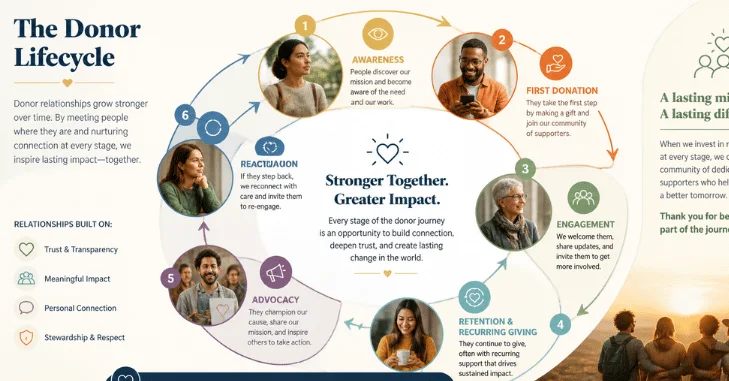
Different fundraising organizations use different stage names. The Giving Block, for example, groups the process around acquisition, retention, and upgrades. Bloomerang describes stages ranging from awareness through possible reactivation.
The exact labels matter less than consistent definitions inside your organization. Each stage should describe a recognizable supporter situation. It should also suggest a clear next action for your fundraising team.
1. Awareness
Awareness begins when someone first encounters your organization. They may discover it through search, social media, an event, a friend, or local involvement. At this point, they may know little about your mission.
Your job is to make the mission understandable and credible. Clear stories, useful educational content, community partnerships, and consistent messaging can help. Business strategy’s brand awareness strategies provide related ideas for increasing visibility across several channels.
Do not treat every new visitor as a donor immediately. Give people reasons to understand your work before presenting repeated financial requests. Trust usually develops through several useful interactions.
2. Acquisition
Acquisition happens when an interested person enters your supporter database. They might subscribe, attend an event, volunteer, sign a petition, or make their first contribution. Their behavior gives your team permission to continue the relationship.
Record the source of that acquisition whenever possible. Knowing whether supporters arrived through events, referrals, search, or campaigns improves future planning. It also helps identify channels that attract people likely to remain engaged.
Corporate relationships can create another acquisition path for nonprofit organizations. Businesses often support charitable work through community programs, volunteering, sponsorships, or philanthropic commitments. Business Strategy’s explanation of CSR’s meaning and examples shows how community support fits broader corporate responsibility programs.
3. First Gift
The first contribution represents an important change in the relationship. Someone has moved from interest to financial action. That moment deserves immediate acknowledgment and careful follow-up.
Send the receipt quickly, but do not stop there. Thank the person clearly and explain what their contribution helps accomplish. The next message should reinforce impact rather than immediately requesting more money.
The first donation also provides useful behavioral information. Record the campaign, amount, channel, designation, and communication preferences. That data helps shape the next stage without making assumptions about future capacity.
4. New-Donor Onboarding
The period after the first donation is a major stewardship opportunity. New supporters need confirmation that giving was worthwhile. They also need simple ways to understand the organization more deeply.
A basic onboarding sequence might include a thank-you, an impact story, and a mission update. It could then invite another form of involvement before making another financial request. Each communication should have one clear purpose.
Automation can make this process easier for small fundraising teams. CRM and email platforms can trigger messages based on donor behavior. BusinessStry’s guide to business software and email automation explains how these systems support organized communication.
5. Retention and Ongoing Engagement
Retention means keeping the relationship active after that first contribution. A retained supporter may give again, volunteer, attend events, share campaigns, or engage through several channels. Continued involvement should influence future communication.
Segment supporters using meaningful information instead of sending every person identical messages. Useful fields can include recency, giving frequency, interests, campaign source, and preferred communication channel. Those categories help teams make messages more relevant.
The goal is not constant contact. Communication should give supporters evidence that their participation matters. Impact reports, beneficiary stories, program updates, surveys, and personalized acknowledgments can all support that purpose.
What Metrics Should Nonprofits Track?
Fundraising teams need more than total revenue to understand relationship health. Revenue shows what happened financially, but it does not explain supporter movement. Lifecycle metrics make that movement easier to measure.
| Metric | What it tells you | Useful question |
|---|---|---|
| Acquisition rate | How many new supporters enter? | Which channels attract new donors? |
| Second-gift rate | How many first-time donors give again? | Is onboarding encouraging another gift? |
| Retention rate | How many previous donors return? | Are relationships continuing? |
| Recurring-gift rate | How many supporters give automatically? | Are donors building consistent habits? |
| Upgrade rate | How many increase support? | Are engaged donors deepening involvement? |
| Reactivation rate | How many lapsed donors return? | Are re-engagement efforts working? |
Review these numbers by donor group whenever possible. An organization-wide average can hide differences between new and established supporters. A small improvement within one weak stage can have meaningful long-term effects.
Create a simple quarterly dashboard rather than tracking dozens of numbers. Choose several measures connected to decisions your team can influence. Assign responsibility for reviewing each metric and acting on changes.
Upgrade Engaged Supporters Without Treating Everyone Like a Major Donor
Some retained supporters will gradually increase their involvement. They might become recurring donors, event sponsors, peer fundraisers, volunteers, or major-gift prospects. The next request should reflect demonstrated engagement.
Do not assume every loyal supporter wants to give substantially more. Financial capacity, personal priorities, and preferred involvement differ widely. Ask for an appropriate next step based on available evidence.
Advocacy can also deepen relationships without requiring another donation. Loyal supporters may introduce friends, share campaigns, or represent a cause publicly. Business Strategy’s brand ambassador guide offers useful parallels for managing long-term advocates and measuring meaningful participation.
What Happens When a Donor Becomes Lapsed?
A lapsed donor has stopped giving within your organization’s defined period. That status should trigger a different communication strategy. Sending the same standard appeal may ignore the supporter’s history.
Start by acknowledging the previous relationship. Share a meaningful update and give the person a reason to reconnect. You can also ask whether communication preferences or circumstances have changed.
Not every former supporter will return. Keep reactivation efforts proportionate to prior engagement and likely value. Respecting preferences protects trust even when another contribution does not follow.
Build a Simple Lifecycle System for Your Nonprofit
You do not need a complex database before starting. Begin by defining a small set of stages that your team can identify consistently. Six or seven clear categories are usually easier to manage than dozens.
Next, define one primary action for each stage. Awareness may require education, while a new donor needs gratitude and onboarding. A lapsed supporter may need a thoughtful re-engagement message.
Finally, create simple rules that move people between stages. These rules might depend on donation dates, recurring status, engagement, or gift frequency. Review the definitions periodically because supporter behavior can change.
Common Donor Management Mistakes
One frequent mistake is focusing heavily on acquisition while neglecting new supporters afterward. Another is using donation amount as the only meaningful segmentation field. Both approaches ignore important relationship signals.
Organizations also struggle when fundraising information sits across disconnected tools. Staff may not know which message a supporter already received. Centralized records reduce duplication and improve coordination between fundraising, communications, and leadership teams.
A third mistake involves measuring campaign revenue without tracking what happens later. A campaign can look successful while attracting donors who never return. Lifecycle reporting adds the longer-term context needed for better decisions.
Frequently Asked Questions
What is a donor lifecycle?
A donor lifecycle is a framework for tracking how supporter relationships develop over time. It commonly covers awareness, acquisition, giving, retention, upgrades, and reactivation. The model helps nonprofits match outreach with a person’s current relationship to the organization.
Is the donor journey the same as the lifecycle?
The terms overlap, but organizations sometimes use them differently. A journey often describes the supporter’s experience across individual interactions. A lifecycle usually groups that experience into broader relationship stages.
How long does a donor lifecycle last?
There is no universal duration because supporter relationships vary widely. Some people progress quickly, while others remain occasional donors for years. Organizations should define stages around behavior rather than arbitrary deadlines alone.
How can a nonprofit improve donor retention?
Start with prompt gratitude and a useful new-donor onboarding sequence. Then segment communication according to behavior, interests, and giving history. Track second gifts and annual retention so weak points become visible.
What software is needed to manage donor stages?
A nonprofit generally needs a reliable constituent or donor database. Email automation and reporting features can reduce manual work. The best system is one staff members can maintain consistently.
Make the Next Donor Action Clear
A strong fundraising program does more than attract contributions. It helps supporters understand how they can remain involved after each interaction. That requires clear stages, useful data, consistent stewardship, and sensible next actions.
Start by mapping your current supporter database into a few practical categories. Identify the weakest transition and improve that part first. Small improvements in onboarding, retention, or reactivation can strengthen the entire fundraising program.
The most useful lifecycle model is not the most complicated one. It is the model your team can apply consistently and measure over time. Build that system around relationships, then use fundraising results to refine it.